.svg)


Challenge
The client relied heavily on manual print validation, requiring teams of checkers to visually inspect and verify the accuracy of every print batch.
This legacy approach resulted in:
.svg)
High labor costs and staffing requirements

Potential for human error under demanding production timelines

Bottlenecks caused by manual review
.svg)
Limited ability to scale without adding staff
The client wanted to explore AI and automation as a way to modernize their operation, reduce manual workload, and improve quality control.

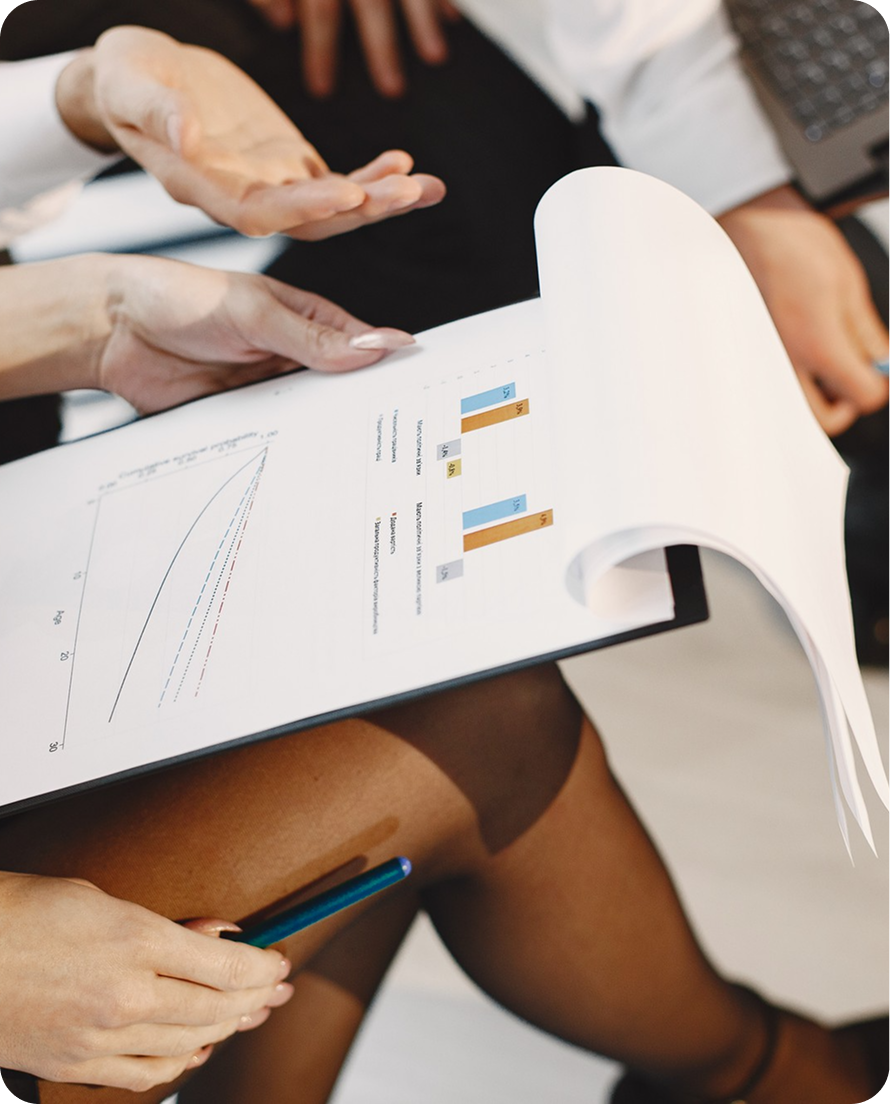

Discovery & Process Evaluation
We began with a detailed discovery phase to understand the client's environment and workflows. Our team examined:
• The end-to-end print validation process
• Pain points, redundancies, and high-risk error areas
• The pre-print cleansing process, error tolerances, and data validation rules
• The full template preparation workflow (design, data mapping, template population)
• Tools in use, such as enterprise print-design and data-management platforms
• Security requirements, access controls, and operational constraints
Stakeholder interviews and workflow audits enabled us to build a complete picture of the current state.

Technical Deep Dive with an AI Expert
To assess feasibility, we brought in an AI specialist to evaluate:
• How AI-based print comparison and anomaly detection could fit into existing workflows
• What integrations would be required with current systems
• Data and model requirements for reliable automations
• Technical constraints within the client’s environment
This analysis helped determine the most viable automation opportunities without disrupting production.


Vendor Evaluation & Selection Support
Next, we conducted a structured vendor evaluation, reviewing multiple companies offering AI-driven print validation or document QA capabilities. We narrowed the list to two strong providers, then:
• How AI-based print comparison and anomaly detection could fit into existing workflows
• What integrations would be required with current systems
• Data and model requirements for reliable automations
• Technical constraints within the client’s environment
This analysis helped determine the most viable automation opportunities without disrupting production.
SOW Development & Project Framework
After the client selected a provider, we collaborated with them to build a clear and actionable Statement of Work (SOW) for a 3-week discovery project. The SOW clearly outlined:
Scope
• Analysis of tools, processes, and data pipelines
• Design of the proposed AI/automation solution
• Definition of technical requirements and integration points
• On-site and virtual discovery workshops
Implementation was intentionally excluded to keep the project focused on evaluation and solution design.
Deliverables
• Solution Design Document
• Current-State Process Documentation
• Data Pipeline Documentation
• Technical Requirements for future implementation
Team
• AI Engineer
• AI Technical Lead
• Business Analyst
• Project Manager
This ensured both clarity and alignment between the client and the selected vendor.

Results
By the end of the engagement, the client had:
.svg)
A validated AI-driven print validation concept
with a clearly defined architecture and workflow integration plan.
.svg)
Complete current-state documentation
including tools, data pipelines, roles, and dependencies.
.svg)
A confident vendor decision
after a structured evaluation and technical comparison.
.svg)
A low-risk roadmap for the next phase
enabling the client to move into implementation with clarity and confidence.
enabling the client to move into implementation with clarity and confidence.
The engagement positioned the organization to automate portions of their previously manual print-checking process, increasing scalability while reducing operational overhead.
Why This Engagement Was Successful
Holistic understanding of operational, technical, and data workflows
A balanced mix of business analysis and AI technical expertise
Objective vendor evaluation
Clear documentation that minimized implementation risks


Our Role
We conducted a focused discovery engagement to assess their current workflows, tools, and data pipelines. This included:
• Mapping the full print validation and template-creation process
• Identifying inefficiencies and automation opportunities
• Performing a technical deep dive with an AI specialist
• Evaluating multiple AI vendors and guiding the client through selection
We also developed a detailed Statement of Work with the chosen provider for a 3-week discovery project focused on solution design.

A validated approach for AI-driven print validation
Documentation of current processes and data flows

A clear solution design and technical requirements
.svg)
.svg)
Subscribe to our newsletter

.svg)

.svg)

.svg)